GPT‑5.6 Sol cuts cost by two‑thirds but raises hallucination risk
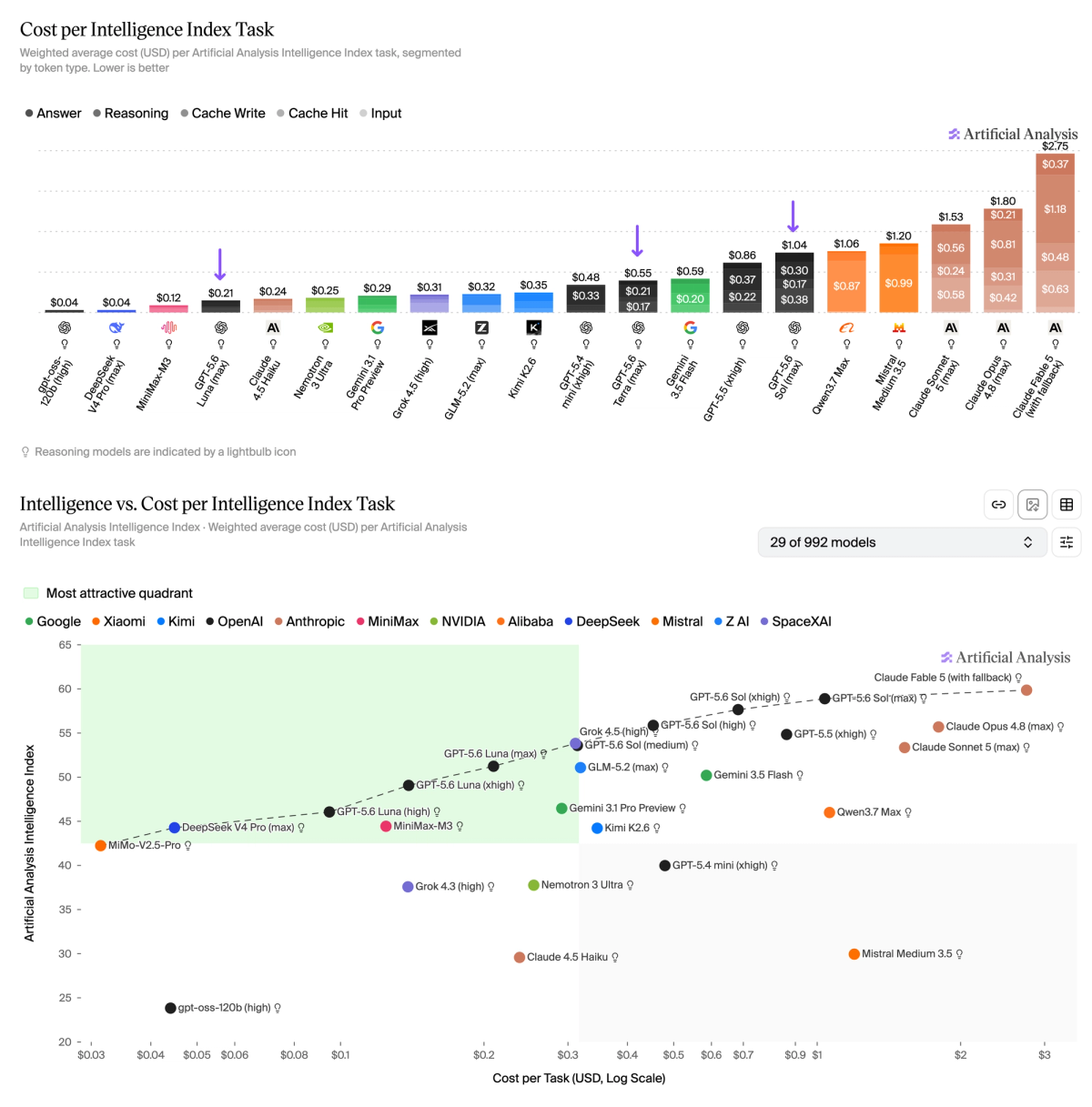
GPT‑5.6 Sol delivers the same Intelligence Index score as Claude Fable 5 for $1.04 per task – about one‑third the price – but introduces a measurable rise in hallucinations.

According to Artificial Analysis, GPT‑5.6 Sol (max) matches Claude Fable 5 (max) on the Intelligence Index with 59 points, yet it charges just $1.04 per task – roughly one‑third of the competitor’s cost. The kicker? The same data set flags a small but noticeable uptick in hallucination rate when Sol is pushed to its top reasoning level.
Cheaper intelligence comes with a higher hallucination price
The benchmark’s AA‑Omniscience slice shows Sol edging up in raw accuracy over GPT‑5.5, but the improvement is paired with a rise in fabricated outputs. Artificial Analysis notes the increase without quantifying it, leaving practitioners to weigh the monetary gain against the risk of misleading content. For any workflow that tolerates occasional errors – such as brainstorming or low‑stakes content generation – the cost advantage may outweigh the downside. For mission‑critical applications, the extra hallucination risk could be a deal‑breaker.
Cost per task: Sol beats Claude Fable 5 by two‑thirds
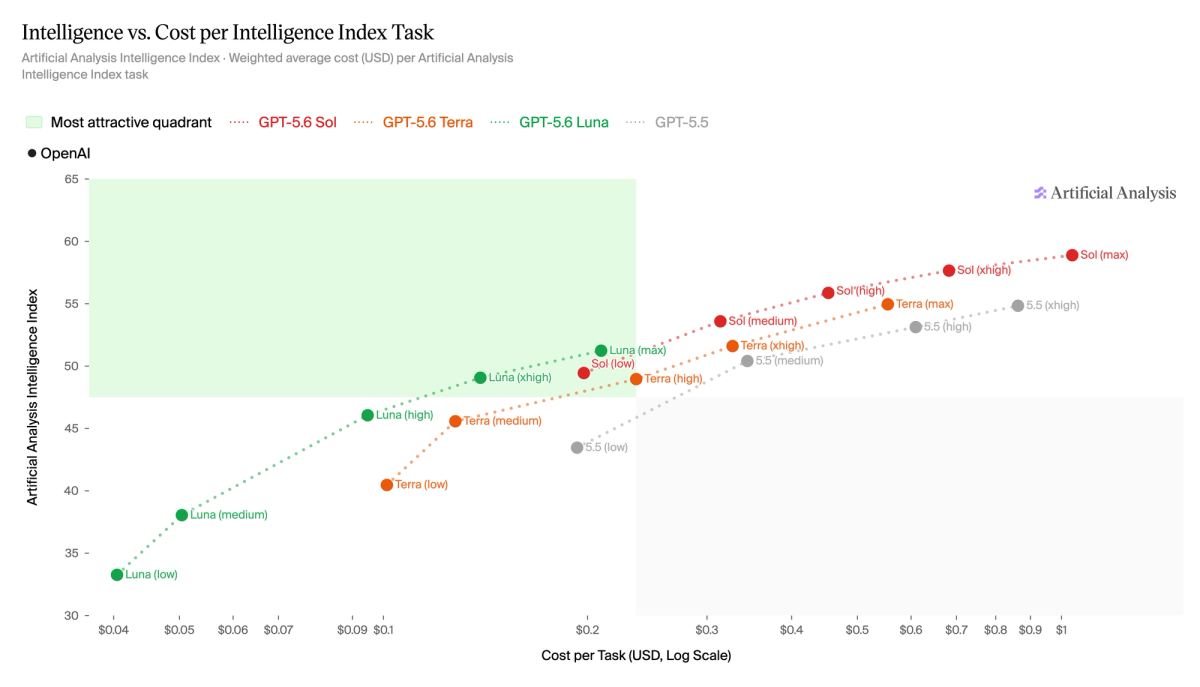
When the cost metric is isolated, Sol’s $1.04 per Intelligence Index task undercuts Claude Fable 5’s implied $3.12 (one third the price). The same analysis reports that Terra and Luna cost $0.55 and $0.21 respectively, representing ~50 % and ~80 % reductions relative to Sol. The cost curve creates a clear Pareto frontier where Sol dominates any Terra effort level – a more intelligent output at no extra expense, or an equal output for less.
Coding prowess: Sol tops the Coding Agent Index
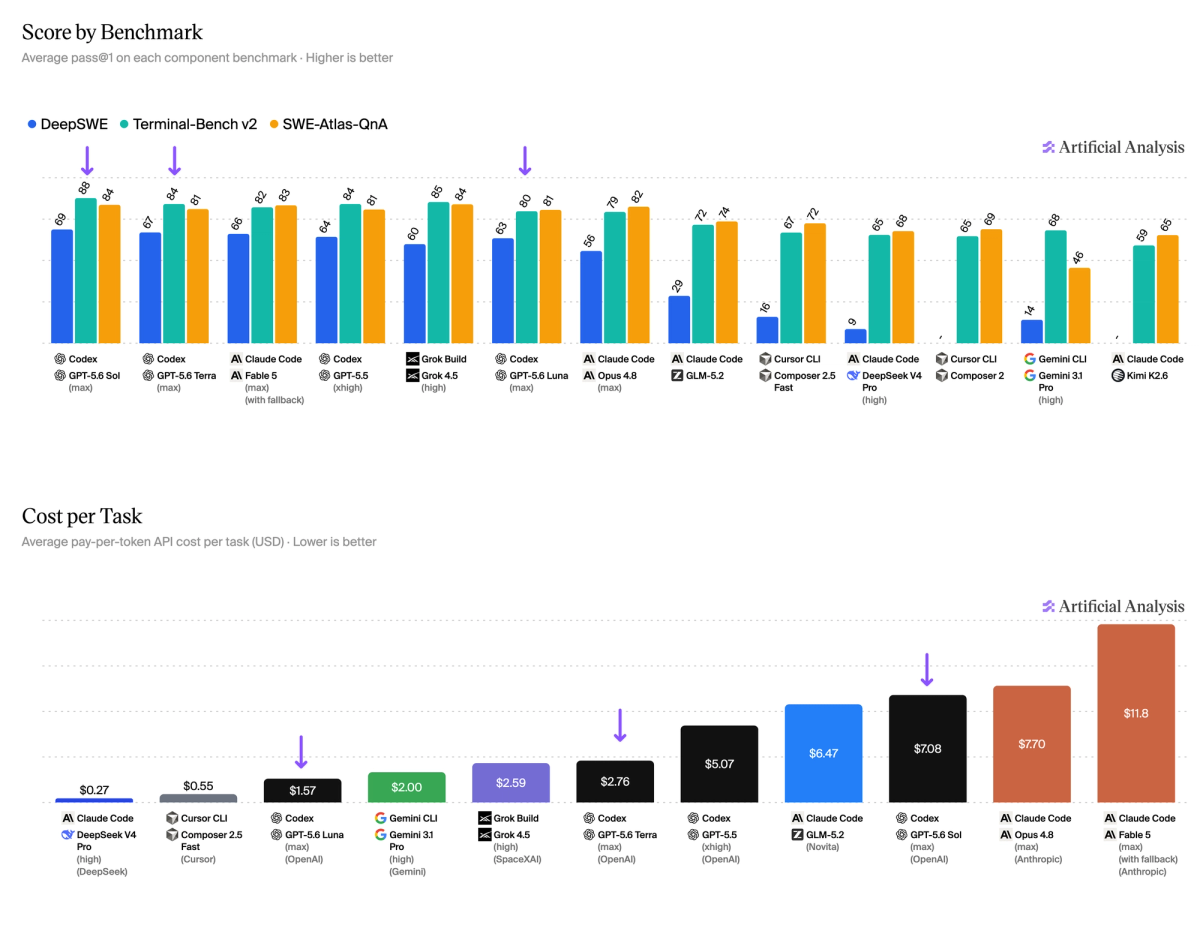
In the Artificial Analysis Coding Agent Index, Sol (max) scores 80 points, outpacing Claude Fable 5 (max) and Opus 4.8 (max) by a margin that translates into ~40 % and ~10 % lower per‑task costs respectively. The index aggregates three frontier evaluations – DeepSWE, Terminal‑Bench v2, and SWE‑Atlas‑QnA – and Sol ties Grok 4.5 only on the SWE‑Atlas‑QnA sub‑test. For developers looking to embed a coding assistant that delivers high‑quality code without inflating cloud bills, Sol’s lead is compelling.
Presentation Elo: Sol leads despite lower rubric score
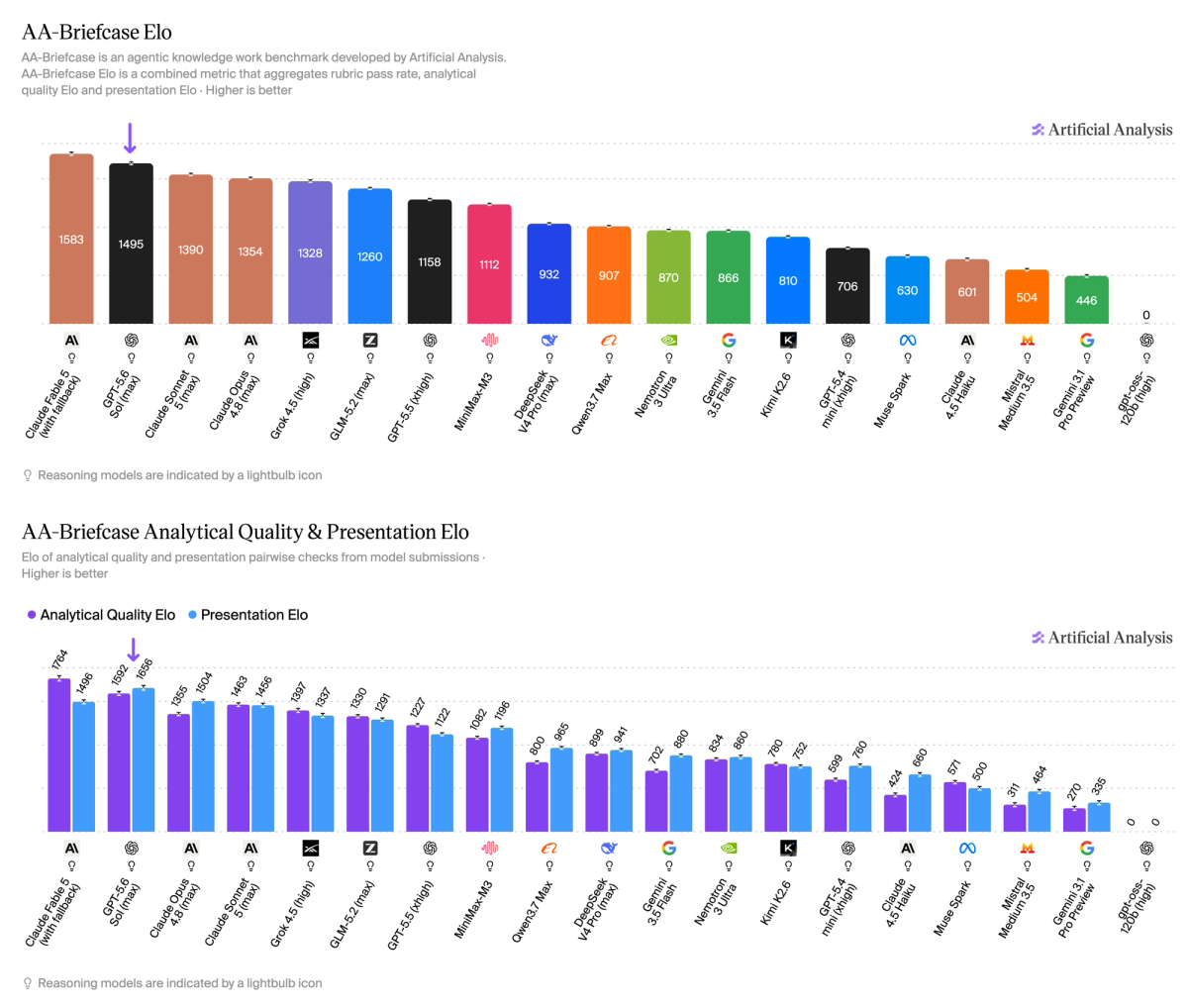
AA‑Briefcase, a benchmark that mimics realistic knowledge‑work tasks, crowns Sol (max) with the highest Presentation Elo of any model. While Claude Fable 5 (max) still wins overall with a Rubric Score of 56 % versus Sol’s 42 %, Sol’s visual output – PowerPoint decks, Excel sheets, and other file types – is judged more attractive. The disparity highlights a trade‑off: superior visual polish versus a lower overall analytical rubric.
Token efficiency and cache‑write pricing: new levers for cost control
Sol’s output token count drops to 15 k per Intelligence Index task, a modest improvement over GPT‑5.5’s 16 k. This token efficiency, combined with OpenAI’s new cache‑write pricing (Sol at $5/$30 per million input/output tokens), reshapes the economics of repeated queries. Artificial Analysis points out that cache writes – tokens stored for future reuse – now carry a 1.25× premium over reads, aligning price with memory consumption. For enterprises that cache prompts, the model’s token frugality can translate into further savings.
Who should adopt GPT‑5.6 Sol now?
If your primary metric is cost per intelligent output, Sol’s position on the Intelligence vs Cost frontier makes it the clear choice. Teams that can tolerate a modest increase in hallucinations – for example, creative writing, early‑stage prototyping, or internal tooling – will reap immediate savings. Conversely, sectors that demand strict factual fidelity – legal drafting, medical advice, or financial reporting – should still vet Sol’s outputs rigorously or stick with higher‑cost, lower‑hallucination models.
Bottom line: Artificial Analysis demonstrates that GPT‑5.6 Sol delivers near‑top intelligence at a fraction of the price, but the cost cut comes with a measurable rise in hallucination risk. The decision hinges on whether your use case can absorb that risk in exchange for the headline‑grabbing savings.