Field notes
Blog
Ideas for teams that make things: product decisions, working methods, and dispatches from inside Geiger Studios.
 Latest dispatch
Guides
Per-ticket registration questions: collecting attendee details before payment
One buyer, five tickets, one name. Here is why custom questions belong on the ticket type, why they should be asked once per attendee, and why they must be collected before checkout.
Read dispatchAll Blogs
15 notes
Six conditional registration form examples (and when to use each)
Workshop pickers, dietary follow-ups, exhibitor details, plus-ones, accessibility and approvals: six conditional logic patterns that keep an event registration form short without losing the data you need.

Event registration software with conditional forms: a buyer's checklist
Most registration tools let you add custom questions. Far fewer let those questions react to each other, change per ticket, and feed the rest of the event. Here is what to check before you pick one.
Selling tickets fairly: reserved seating, anti-scalping and faster entry
A good on-sale gets tickets to real fans at a fair price and gets them through the door quickly. Here is how seat maps, ticket binding, resale caps, pricing rules and tap-to-enter fit together.
Looking for an Eventbrite, Cvent or Luma alternative? Start with these five questions
Event platforms are built for very different events. Before comparing feature lists, answer five questions about your own events — they narrow the field faster than any comparison table.
Conference management software: the whole stack, from call for papers to certificates
A conference is eight or nine separate jobs that all share one attendee list. Here is each stage, what the software has to do at that stage, and where the handoffs usually break.
Running recurring events and memberships without rebuilding everything each week
Weekly classes, monthly meetups and member programmes all share one problem: the setup work repeats. Here is how series, templates, memberships and automations take the repetition out.
Geiger Chat now lives inside Geiger Flow
The full Geiger Chat workspace — messages, channels, calls, files and inbox — now runs inside a Flow project's Grounding tab, scoped to the project instead of the organization.

GPT‑5.6 Sol cuts cost by two‑thirds but raises hallucination risk
GPT‑5.6 Sol delivers the same Intelligence Index score as Claude Fable 5 for $1.04 per task – about one‑third the price – but introduces a measurable rise in hallucinations.
Grok 4.5: The cheapest near‑frontier model that also hallucinates twice as much
At $0.31 per Intelligence Index task, Grok 4.5 undercuts rivals, yet its hallucination rate jumps from 25% to 54%, raising safety concerns for cost‑focused adopters.
Muse Spark 1.1 Review: Meta Scores 51 on the Intelligence Index - Benchmarks, Cost Per Task & Where It Still Lags
Meta's Muse Spark 1.1 scores 51 on the Artificial Analysis Intelligence Index at ~$0.26 per task — but its 4x factuality gain came from abstention, not accuracy.

AutomationBench-AA: How AI Agents Perform on Real SaaS Workflows (and Why They All Break the Rules)
A new benchmark from Zapier and Artificial Analysis tested AI agents on 657 real SaaS workflow tasks. Anthropic's models lead — but every model breaks business rules, and Finance automation is still the weak spot.

Claude Sonnet 5 Review: Benchmarks, Cost Per Task & How It Compares to Opus 4.8
Claude Sonnet 5 scores 53 on the Artificial Analysis Intelligence Index and matches Opus 4.8 on agentic tasks — but at standard pricing it costs more per task than the model it's supposed to undercut. Here's what the numbers actually show.
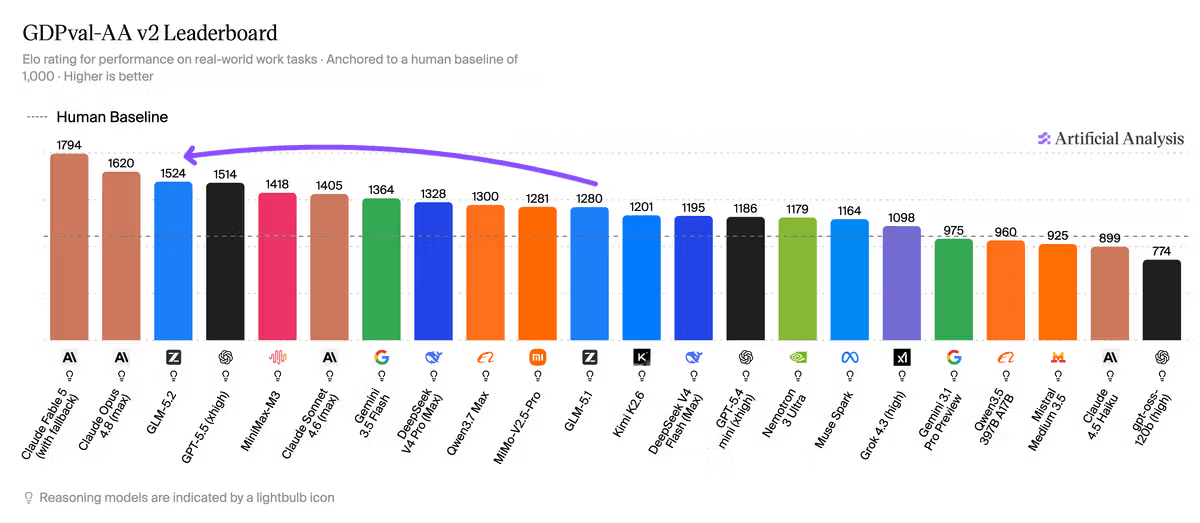
GLM-5.2 Review: Benchmarks, Cost & How It Compares to DeepSeek and MiniMax.
GLM-5.2 tops the open weights leaderboard with a score of 51 on the Intelligence Index. Here's a breakdown of its benchmarks, cost per task, and how it stacks up.
Introducing Geiger Flow 2.0
We're excited to announce the release of Geiger Flow 2.0 with revolutionary new features for workflow automation.
Getting Started with Geiger Notes
Learn how to make the most of Geiger Notes with this comprehensive beginner's guide.