Muse Spark 1.1 Review: Meta Scores 51 on the Intelligence Index - Benchmarks, Cost Per Task & Where It Still Lags
Meta's Muse Spark 1.1 scores 51 on the Artificial Analysis Intelligence Index at ~$0.26 per task — but its 4x factuality gain came from abstention, not accuracy.
Muse Spark 1.1 Gained Eight Points in Three Months. The Number That Matters Most Went Down.
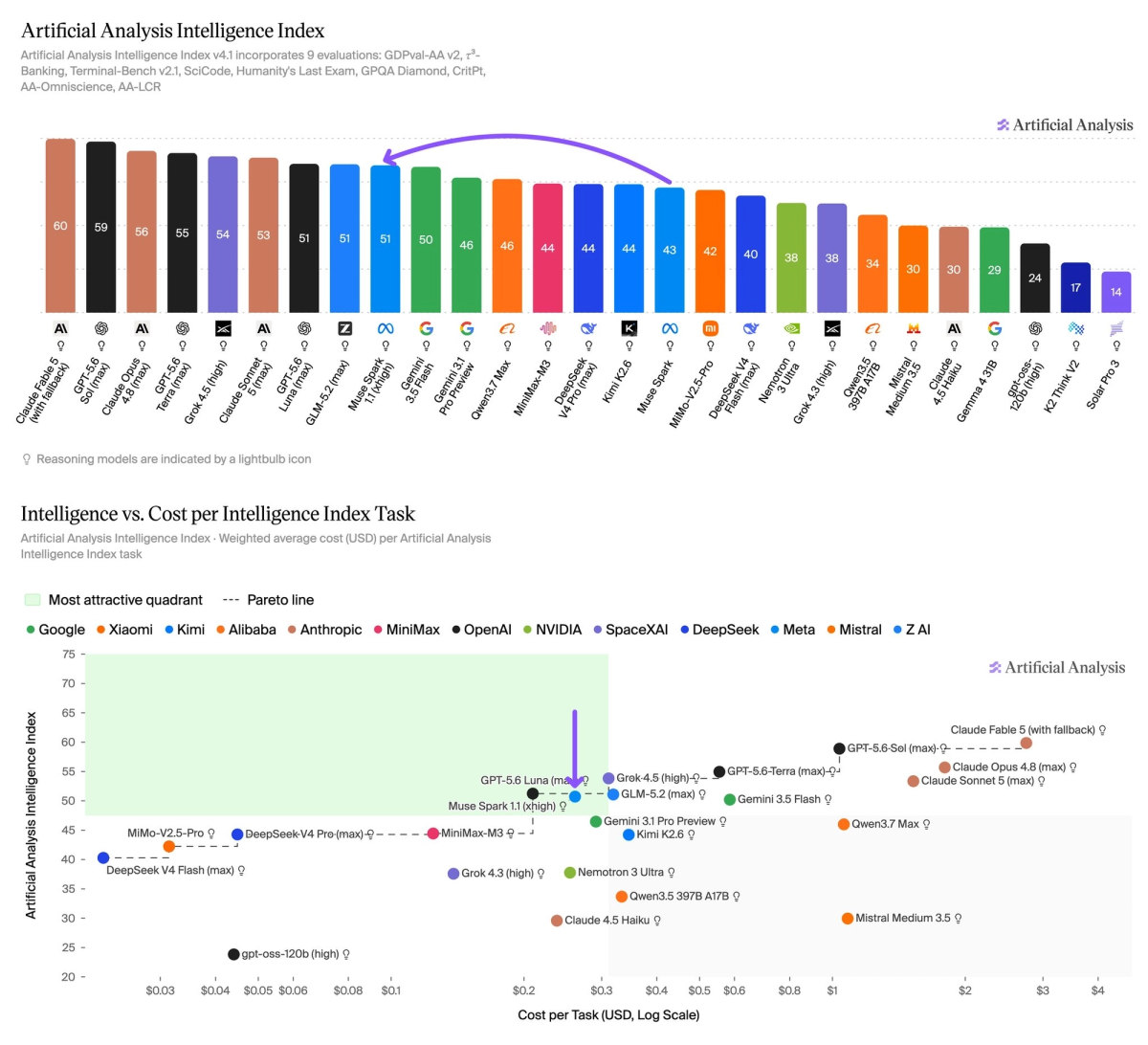
Meta's Muse Spark 1.1 lands at 51 on the Artificial Analysis Intelligence Index, eight points up from Muse Spark 1.0's 43 — a jump the previous version took a full release cycle to set up and this one delivered in about a quarter. At 51 it sits level with GLM-5.2 (max), GPT-5.4 (xhigh), and GPT-5.6 Luna (max), three points behind Grok 4.5 (high) at 54, with the frontier still occupied by Claude Fable 5 (60), GPT-5.6 Sol (59), and Claude Opus 4.8 (56).
That's the headline, and it's a good one. But the single most eye-catching figure in Artificial Analysis's evaluation is the AA-Omniscience score, which went from 4 to 18 — more than a quadrupling. Read that as "the model got dramatically more knowledgeable" and you'd be wrong. Its accuracy on those questions actually fell, from 45% to 41%.
The score went up because the model stopped guessing. That's the story worth spending this post on, because it changes what you should expect from this model in production.
Where the eight points actually came from
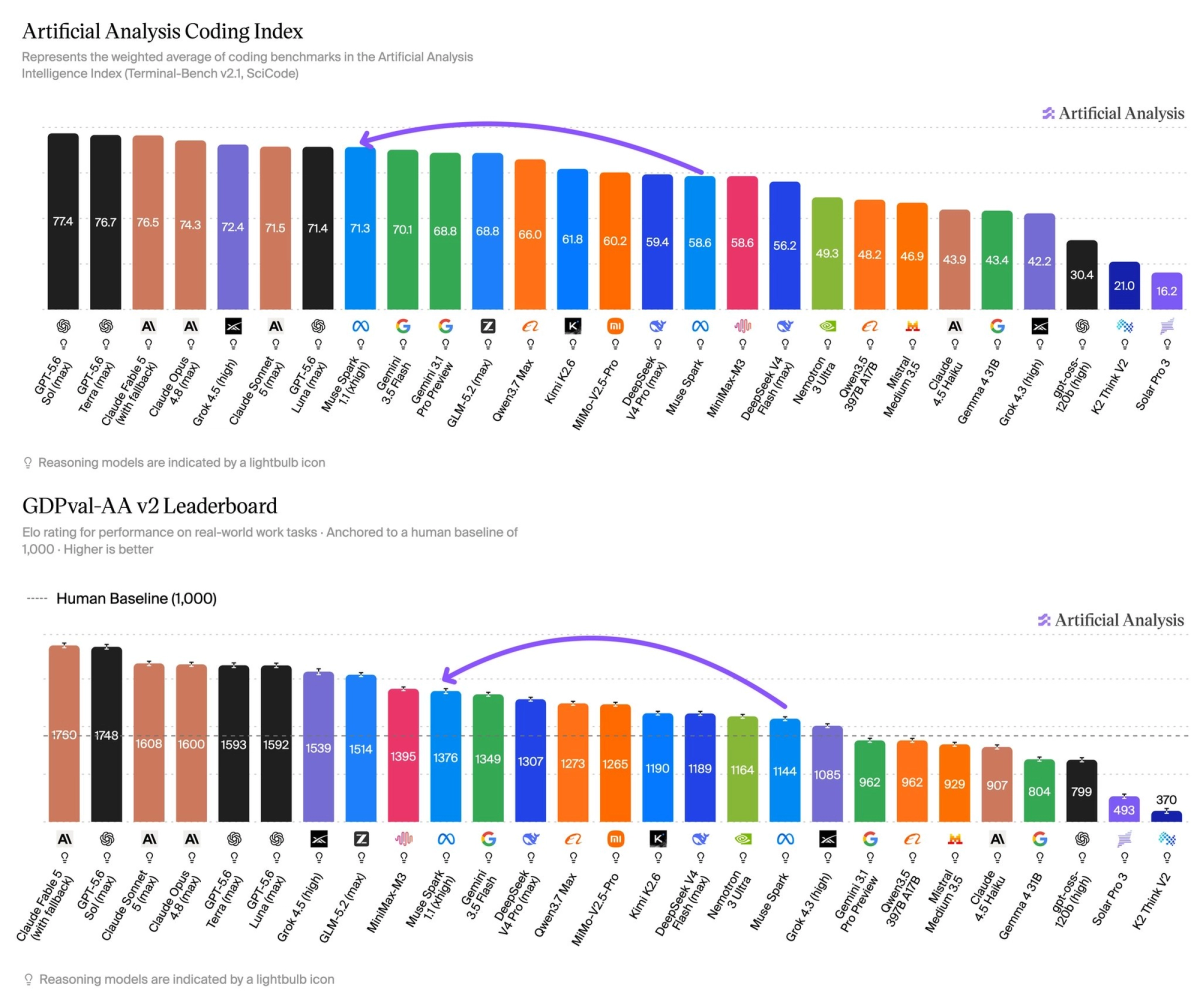
The gains are concentrated, not broad. Artificial Analysis's breakdown puts them in Scientific Reasoning, Coding, and Knowledge, and the coding numbers carry the most weight: the Coding Index climbed 12 points, from 59 to 71. SciCode rose from 52% to 58%, and TerminalBench contributed as well.
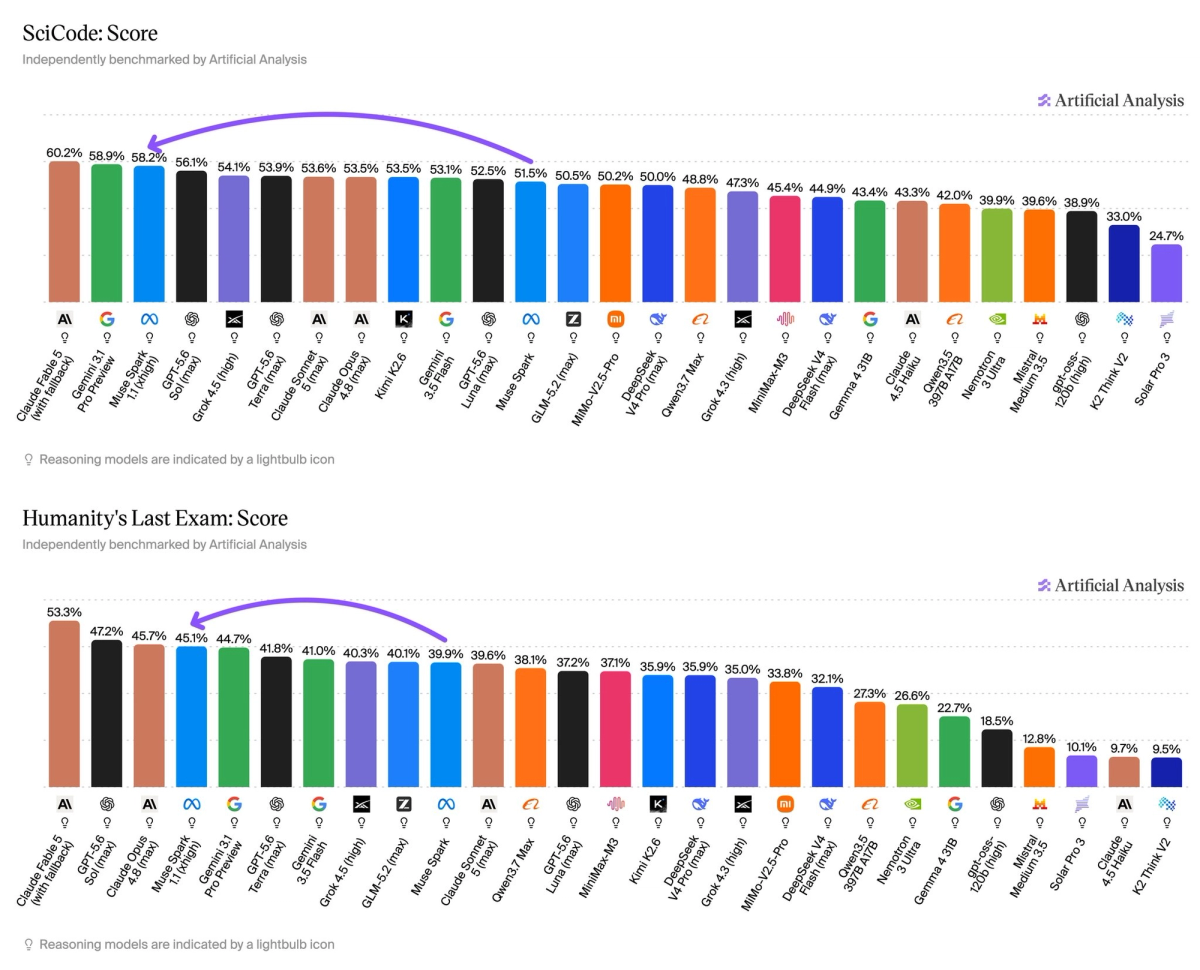
The SciCode result is the one that should make people pay attention. At 58%, Muse Spark 1.1 ranks third across everything Artificial Analysis has benchmarked — behind only Claude Fable 5 (60%) and Gemini 3.1 Pro Preview (59%). A model sitting nine points below the frontier on the composite index is within two points of the leader on scientific coding. That is a very specific kind of good, and it suggests Meta pushed hard on a narrow, valuable target rather than lifting everything at once.
Humanity's Last Exam tells a similar story: 45%, up five points, which puts it within a point of Claude Opus 4.8 (46%) and ahead of both GPT-5.5 (44%) and Grok 4.5 at high effort (40%). Opus 4.8 is five points clear on the Intelligence Index overall. On this particular hard-knowledge eval, the gap essentially disappears.
Agentic knowledge work improved the most in raw terms — GDPval-AA v2 rose 232 Elo, from 1144 to 1376 — and still lags the frontier. Big movement, still behind. Both things are true.
The factuality gain is a behaviour change, not a capability gain
Here's where it gets uncomfortable, and where a lot of coverage is going to get it wrong.
AA-Omniscience went from 4 to 18. Underneath that, per Artificial Analysis's numbers, the hallucination rate collapsed by 35 points — from 73% down to 38%. The attempt rate fell from 95% to 82%. And accuracy slid from 45% to 41%.
Put plainly: Muse Spark 1.1 does not know appreciably more than Muse Spark 1.0 did. It has learned when to decline. Nearly one in five questions now goes unanswered where the previous version would have taken a swing, and the swings it used to take were wrong roughly three-quarters of the time.
This is genuinely valuable, and I'd argue it's more valuable than four points of accuracy would have been. A model that confidently invents an answer 73% of the time it's out of its depth is unusable for anything customer-facing without a verification layer bolted on top. A model that says nothing is merely unhelpful, which is a much cheaper failure to handle. Abstention is the right instinct for enterprise deployment.
But name it for what it is. Artificial Analysis points out that Grok 4.5 moved the other direction on this eval — buying its gain with higher accuracy while its hallucination
rate rose. Two models, two philosophies. If your pipeline has a human or a retrieval check downstream, Grok's tradeoff may serve you better. If it doesn't, Muse Spark 1.1's caution is the safer default.
What you should not do is read a 4x jump on a factuality benchmark and conclude the model got four times smarter about facts. It didn't.
The cost case is the strongest part of the release
This is where Muse Spark 1.1 separates itself from the models it ties with.
Artificial Analysis found it used 94M output tokens to complete the Intelligence Index — the leanest of the group, clustered at 51. GPT-5.4 (xhigh) needed 109M. GPT-5.6 Luna (max) needed 125M. GLM-5.2 (max) needed 141M, half again as many tokens for the same score.
Combine that restraint with Meta's pricing of $1.25 per million input tokens and $4.25 per million output, and Artificial Analysis estimates roughly $0.26 per Intelligence Index task. GLM-5.2 comes in at $0.37 for the same score. GPT-5.4 costs about $0.89 — roughly three times as much to land in the same place. Among models at or above its intelligence level, only GPT-5.6 Luna ($0.21) runs cheaper.
If you are currently paying GPT-5.4 prices for a 51-point workload, that comparison is the entire reason to read this release.
The honest tradeoff: it's efficient, not fast, and it's single-sourced
Two caveats sit next to that cost story.
The token efficiency is relative, not absolute. Muse Spark 1.1 is lean compared to its immediate peers, but Artificial Analysis notes it burns more tokens than several models that score higher — Claude Fable 5 and Grok 4.5 (high) among them. It's the efficient choice within its tier, not efficient in general.
The bigger practical constraint is availability. At launch
, Artificial Analysis lists Meta's first-party API as the only route to the model. No third-party hosts, no failover, no price competition among providers. Throughput measures around 114 output tokens per second at the median, with about 21 seconds before the first answer token arrives — fine for batch and agentic work, noticeably long for anything interactive.
One more thing worth stating plainly: Artificial Analysis conducted this evaluation pre-release in coordination with Meta. The numbers appear to be the standard harness applied consistently, and the unflattering ones (accuracy down, GDPval still behind) are published right alongside the good ones. But it's a pre-release collaboration rather than a cold third-party run, and that's context a careful reader should carry into it.
Specs
Intelligence Index: 51 (xhigh effort), up from 43
Context window: 1M tokens, up from 262k
Pricing: $1.25 / $4.25 per 1M input/output tokens; cache hits at $0.15 per 1M
Output speed: ~114 tokens/sec median, ~21s time to first answer token
Availability: Meta's first-party API
Bottom line
If you're running high-volume scientific or coding work and currently paying frontier prices for it, Muse Spark 1.1 deserves a bake-off this week. SciCode at 58% and a Coding Index of 71 at $0.26 per task is a serious value proposition, and the 1M-token context makes it viable for the long-document work that used to force you up a tier.
If you're building anything user-facing where a wrong answer is expensive, the abstention behavior is a feature — but test what "declining" actually looks like in your prompt format before you commit, because an 82% attempt rate means the model will go quiet on you and you need to know how it does that.
If you need the top of the leaderboard, nothing here changes your calculus. Fable 5 is still nine points ahead, and the GDPval-AA v2 gap on real agentic knowledge work is real despite a 232-Elo leap.
The number to watch on the next release: accuracy. Meta bought its factuality gain with silence this time. Doing it again requires the model to actually know more.